
Vending Machine vs. Micro Market: Which Is Better for Your Property?
Almost every comparison of these two formats is written for vending operators deciding what to buy. If you are the property, that is the wrong math — you are not buying either one.
What you are choosing is what goes in your building and how it behaves once it is there. I install and service these myself across Aurora, Naperville, Elgin, and the rest of the western suburbs, so most of what follows comes from walking properties and seeing which format actually gets used.
This page walks the differences that land on you: how much room each one takes, how each holds up on security, what people can buy, what the experience feels like, and where the money question really sits. Then it gets specific by property type, because an apartment lobby in Oak Park and a warehouse floor off I-88 are not the same decision.
- A vending machine is one enclosed unit. A micro market is a small unattended store — coolers, shelving, and self-checkout in an open area.
- Space is the first filter, but power is the constraint that usually decides it.
- Selection is the widest gap. Cantaloupe puts vending around 40–50 selections and micro markets at 150–400+.
- Security is where the industry genuinely disagrees, and this page says so rather than picking the convenient side.
- Cost is the factor that matters least to you under a full-service placement model. The provider carries it either way.
The real difference between the two
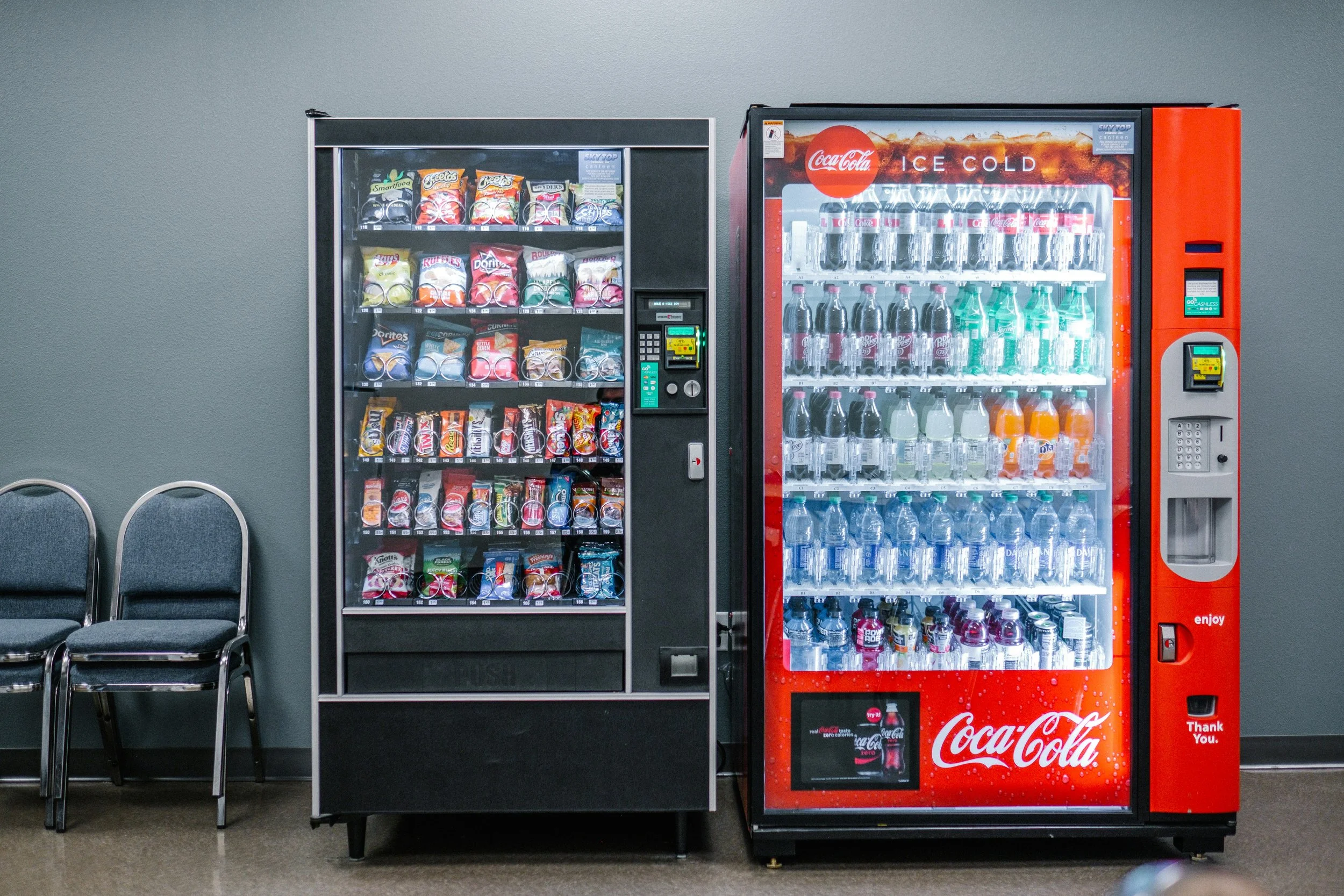
A vending machine is a sealed box. Product sits behind glass, a mechanism delivers it, and the transaction is one item at a time. The footprint is a slot along a wall, and the modern ones take a tap of a card rather than a folded dollar bill.
A micro market removes the box. It is an unattended retail space: glass-door coolers, open shelving, and a self-checkout kiosk or tap-to-pay terminal. People pick things up, read a label, put something back, and buy three items in one transaction. There is no mechanism between the customer and the product, which is the source of both its advantages and its one real risk.
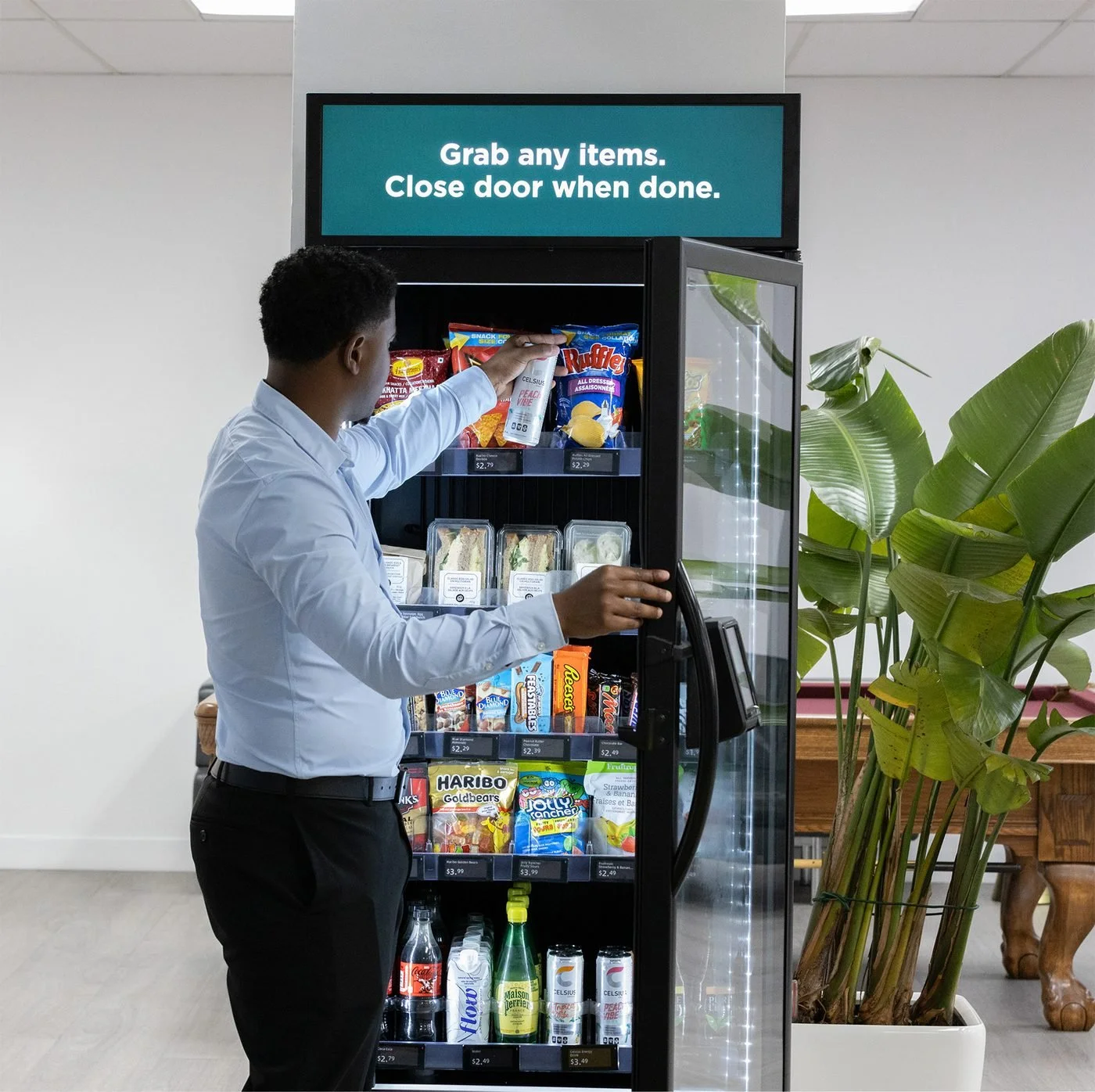
There is also a middle format worth naming, because it resolves a lot of the debate below: the smart cooler. The door is locked until a card is authorized, then it opens, the customer takes what they want, and closing the door charges them for it. It gives you micro market selection and browsing with vending-level control over the product.
Space and footprint
A vending machine needs a flat stretch of wall and clearance in front of it. A hallway alcove, a corner of a break room, or a spot beside the elevators all work.
A micro market needs a defined area rather than a slot — room to stand, browse, and get past someone who is already browsing, plus a place for the checkout unit. That does not mean a dedicated room. A corner of an existing break room, a section of a lobby, or an underused lounge is the common setup. In a lot of the older buildings out here, the spot that ends up working is a former smoking lounge or a coffee nook nobody reorganized since the nineties.
Power decides more of these than square footage does. Refrigeration runs continuously, so either format needs a dedicated, grounded 120V outlet that is live 24 hours a day — not on a circuit that gets cut overnight or over a holiday weekend. If the wall you have in mind does not have the right power, that is usually the only real prep work involved.
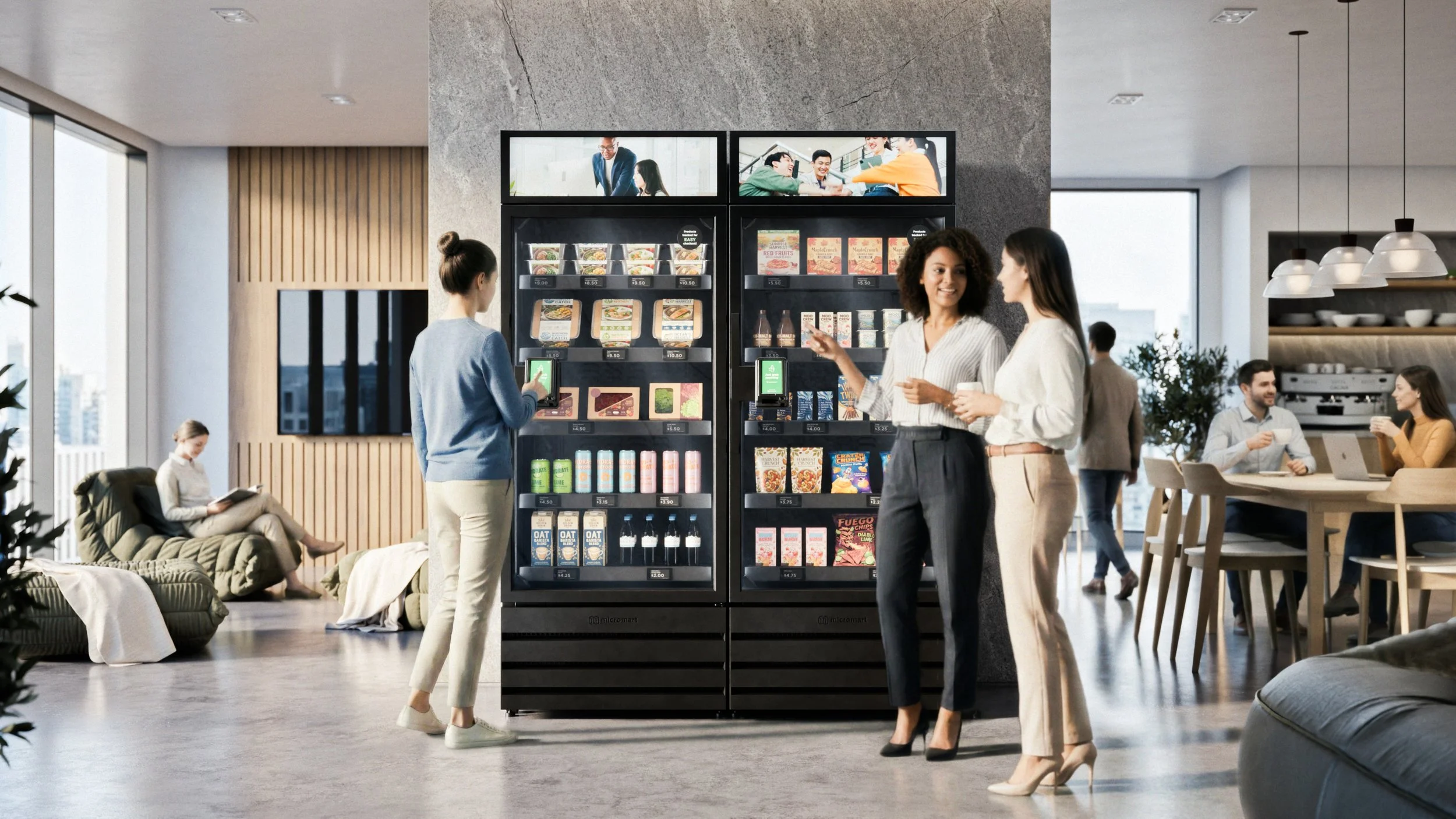
This is a mockup render used to illustrate placement, not a photo of a specific property.
Security, trust, and shrinkage
A vending machine is secure by design. The product is locked behind glass and the machine will not release it until it has been paid for. There is not much to debate.
Open shelving is different, and this is the one place where the industry does not agree with itself. It is worth showing you both sides rather than quoting whichever one is convenient.
On one side: Cantaloupe has reported micro markets performing well in residential buildings and fitness centers, citing operators seeing average transactions of $4.13 in apartment buildings and $5.69 in fitness centers, and describing those locations as working partly because of their secure nature and around-the-clock access.
On the other: the VMFS USA 2026 operator guide argues the open-shelf format requires social accountability from the customer base, and cites William Blair research finding that theft has limited micro market rollout to closed-loop environments like corporate offices and university campuses.
Both are describing something real. The variable underneath them is not the property type on the sign out front — it is how known and how repeat the population is. A 40-unit courtyard building in Glen Ellyn where residents recognize each other is not the same environment as a high-rise lobby with deliveries and guests moving through all day, even though both are technically "apartments."
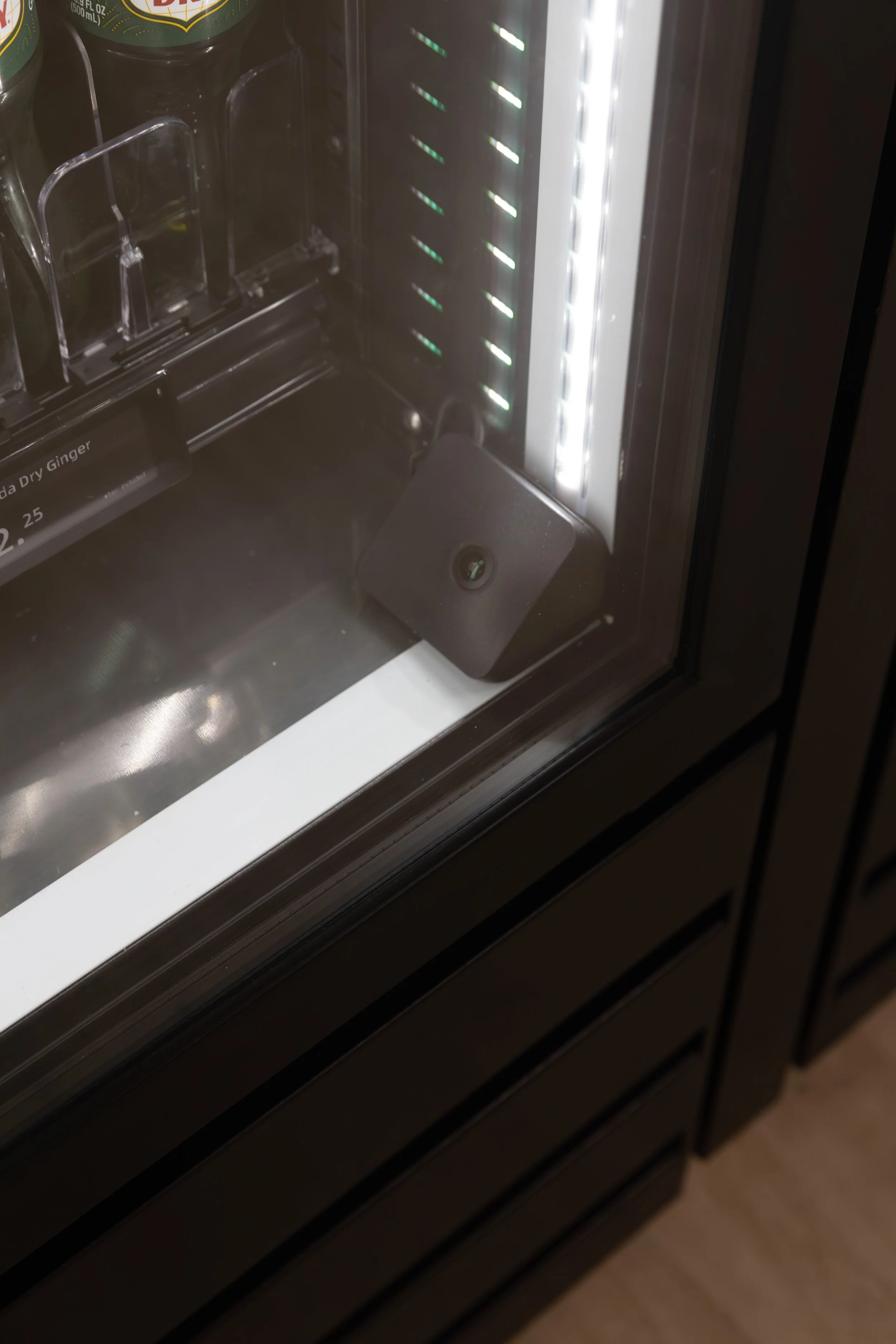
What has changed since that concern took shape is worth weighing too. Markets today are cashless, so there is no cash on site and nothing worth breaking into for money. Units are camera-monitored, with vision sensors tracking what comes off the shelf. And where a space is genuinely less controlled, a locked smart cooler solves the problem outright rather than relying on honesty. We would rather tell you that than quote a shrinkage percentage we have not measured at your property.
Product variety and freshness
This is the widest measurable gap between the formats. Cantaloupe puts a typical vending machine at 40–50 selections and a micro market at 150–400 or more.
The reason is mechanical. A vending machine can only carry what survives being pushed off a coil and dropped, which rules out most of what people actually want at lunchtime. A market has shelves and coolers, so sandwiches, salads, yogurt, fresh fruit, and frozen items are all on the table alongside the usual snacks and drinks. It also means I can stock a building for what its people actually buy — the mix in a warehouse off Route 59 looks nothing like the mix in a downtown Naperville office, and after a few restocks it stops being a guess.
Fresh food carries an operating cost, which is rotation. Someone has to pull what is near date and replace it on a schedule. Under a full-service model that is the provider's job and the provider's loss, which is the next section.
Cost, and why it matters less than you think
Search this comparison and you will read the same line everywhere: vending is cheap to deploy, a micro market is a bigger investment. That is accurate — for whoever is buying the equipment.
If you are hosting under a full-service placement model, that is not you. With GrabNGo, the property provides a spot and a dedicated 120V outlet. We cover equipment, installation, product, restocking, servicing, cleaning, maintenance, customer support, refunds, insurance, and removal at the end of the term. That list is identical whether the answer is a machine, a smart cooler, or a full market.
Which takes the entire cost trade-off off your side of the table. You are not choosing between a cheaper option and a better one. You are choosing whichever one fits the space and the people, and the fact that one costs more to install is a fact about our balance sheet, not yours. Here is exactly what the free placement model covers and what it asks of you.
The one case where the traditional comparison still applies to you is if you intend to buy and operate equipment yourself. Then every operator cost in those guides becomes yours, and they are worth reading closely.
The experience difference
A vending machine is familiar and fast. Nobody needs it explained, it works at 2am for one person on a night shift, and it takes up almost nothing.
A market feels like a small store, and that changes what people use it for. They buy lunch instead of a snack, compare two things, check a label. It also reads differently to a visitor. A leasing tour, a candidate walking through on an interview, or a patient's family waiting an hour notices a market in a way nobody has ever noticed a vending machine. And in February, when nobody wants to move a car to get a sandwich, it is the difference between people staying in the building and people leaving for an hour.
The behavior shows up in the data. Cantaloupe's 2025 Micropayment Trends Report, as summarized by Vending Market Watch, put the average micro market ticket at $2.67 against $2.11 for vending, with smart cooler formats at $4.25 — and micro market locations growing 28% in a year. Those are operator revenue figures rather than anything you collect. For a host they are useful as a signal of use: when people can see and handle the product, they buy more of it, and an amenity that gets used is the only kind worth the wall space.
Which is right for your property?
You will find pages that give you a number — 50 people, 150 daily users, 300 employees. They contradict each other badly enough that it is fair to read them as each operator's internal rule of thumb rather than an industry standard. We do not publish one, because the same headcount performs completely differently depending on schedules and what is across the street.
These are the factors that actually decide it:
- Space. A wall, or an area someone can stand and browse in.
- Traffic and timing. How many people are on site, and during which hours.
- How known the population is. Regulars who see the same market daily, or a rotating crowd.
- How controlled the area is. Staff-only, badge access, monitored lobby, or fully public.
- What people want. A drink on the way past, or somewhere to get lunch without leaving.
| Property type | What usually decides it |
|---|---|
| Office | The most natural fit for a market: a known population, controlled access, and a real lunch need. The question is usually how many days a week people are actually in the building. |
| Apartment & multifamily | Strong demand, and the format hinges on where it goes. A resident-only amenity area behaves like a closed setting; a street-facing lobby does not. Smart coolers are often the right answer in the second case. |
| Gym & fitness | High-value baskets — drinks, protein, recovery items — and members who come repeatedly. Floor space is usually the constraint, so a compact cooler setup often beats a full market. |
| Medical | Two different populations. Staff on long or overnight shifts want real food; visitors want something quick. A staff-side market plus a machine or cooler in the waiting area covers both. |
| Industrial & warehouse | Shift coverage matters more than headcount, and out along the I-88 and Route 59 corridors there is frequently nothing within walking distance. Space is rarely the problem; placement relative to break times and the floor is. |
Can you have both?
Yes, and on a larger property it is often the right answer rather than a compromise.
The usual pattern is a market where people gather and take a real break, and a machine or cooler where they only pass through — a far wing, a loading area, an overnight-access lobby. Splitting it that way also resolves the security question by geography: the open format sits in the controlled space, and the enclosed one covers everywhere else.
It is worth planning as one setup rather than adding a second unit later, because the product mix in each spot should be different.
How GrabNGo helps you decide
GrabNGo is me. I place both formats across Chicago and the western suburbs — Aurora, Naperville, Elgin, the Tri-Cities, DuPage — in offices, apartment communities, gyms, medical buildings, and industrial facilities, and I am the one restocking them. Because there is no cost to you either way, I have no reason to talk you into the bigger installation. I would rather put one cooler somewhere it gets used than a full market somewhere it does not.
A walkthrough takes about twenty minutes. I look at the space, the power, who is in the building and when, and how controlled the area is, then tell you which format fits — or that none does. You will get that answer instead of a proposal. Being local is most of why that works: I am not routing a decision through a regional office, and if something goes wrong I am the one driving over.
Frequently asked questions
What's the main difference between a vending machine and a micro market?
A vending machine is a single enclosed unit that dispenses one item at a time from behind glass. A micro market is a small unattended store — open shelving and glass-door coolers with a self-checkout kiosk — where people pick up the product themselves and buy several items in one transaction. The practical differences are selection, footprint, and how the space needs to be controlled.
Which is more secure against theft?
A vending machine, straightforwardly, because product stays locked until it is paid for. Micro markets rely on an open format, and industry sources genuinely disagree about how well that holds up in semi-public spaces: Cantaloupe reports strong performance in residential buildings and gyms, while the VMFS operator guide cites William Blair research that theft has kept micro markets largely in closed settings like offices and campuses. Modern markets are cashless and camera-monitored, and where a space is less controlled, a locked smart cooler gives you market-style variety without relying on an honor system.
Is a micro market only for large offices, or can smaller properties support one?
Smaller properties can and do support them. We do not publish a minimum headcount, because the same number of people performs very differently depending on schedules, on-site days, and what is within walking distance. What matters is space, consistent traffic, how controlled the area is, and what people actually want — assessed property by property.
Does a micro market cost more than a vending machine?
To the operator, yes. To you as the host under a full-service placement model, neither one costs anything. GrabNGo covers equipment, installation, product, restocking, servicing, cleaning, support, refunds, insurance, and removal for either format. The property provides a spot and a dedicated 120V outlet, so the decision comes down to fit rather than budget.
Can I have both a vending machine and a micro market on the same property?
Yes, and on larger properties it is often the best setup. A market goes where people gather and take a full break; a machine or smart cooler covers areas people only pass through, or spaces that are less controlled. Planning both at once lets us stock each one differently for how it will be used.
If you are weighing the two formats for a specific building, the fastest way to settle it is to have someone look at the space.
Or call (630) 864-5679, email info@getgrabngo.com, or request a walkthrough.

Owner and operator of GrabNGo. Joshua installs, stocks, and services every micro market and cooler himself across Aurora, Naperville, and the greater Chicago suburbs. More about GrabNGo